


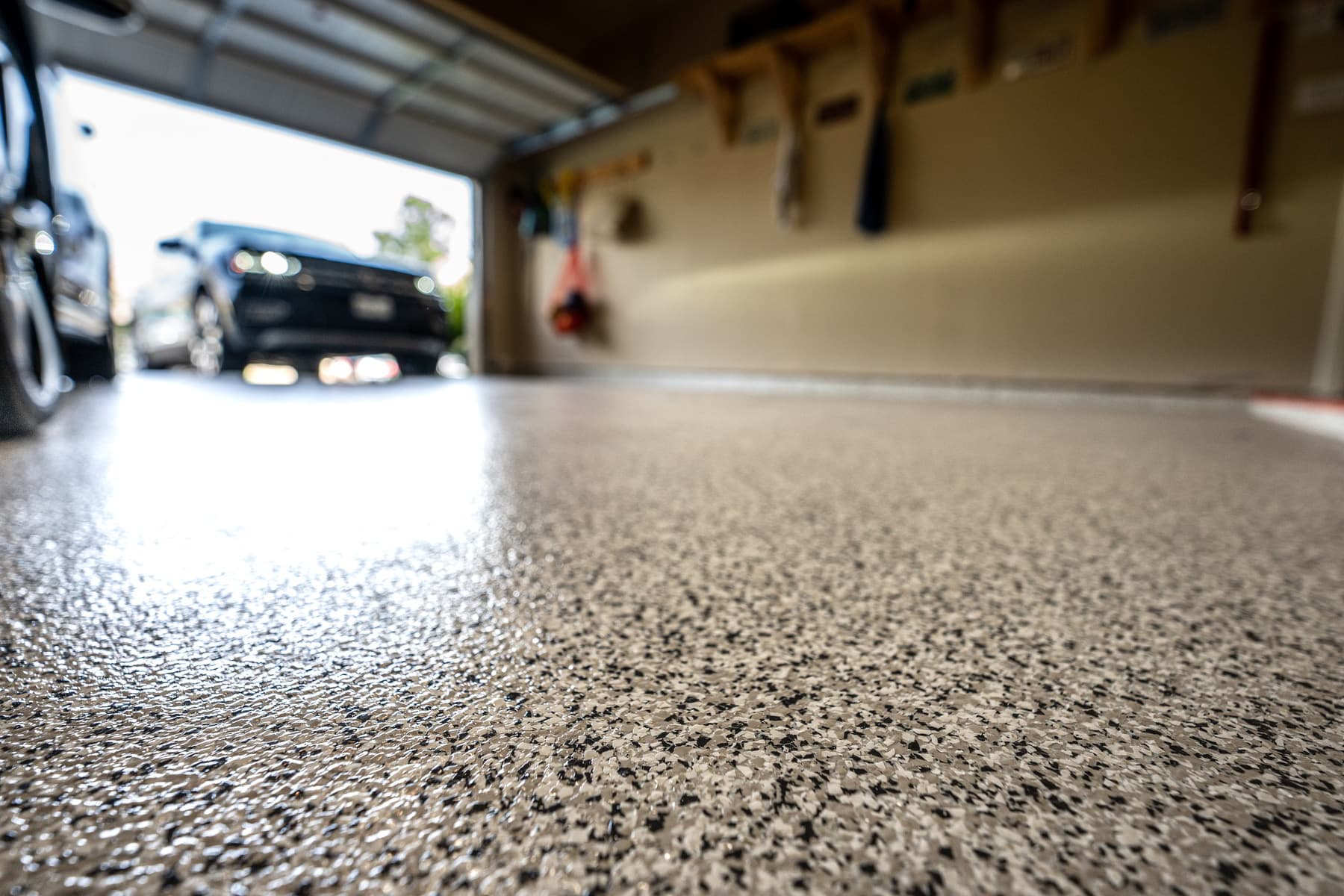
The garage is the most honest room in a coastal house, because nothing in it is staged for company. Everything the Grand Strand lifestyle generates eventually parks there: the golf cart and its sandy tires, the beach wagon shedding yesterday’s dunes, the fishing gear still dripping brine, the second fridge, the bikes, the power washer, the cooler collection, and the ambitious project that was supposed to take exactly one weekend, two summers ago. And under all of it, in most homes around here, sits the one floor in the house nobody ever actually chose: bare gray builder-grade concrete — porous, perpetually dusty, thirsty for every drip of oil it can reach, and lit by that one sad ceiling bulb to look its absolute grayest.
It does not have to stay that way — and that is not merely a flooring-store opinion talking: epoxy flooring installation and decorative coating sit right on the Waccamaw Floor Covering services menu, beside the carpet and tile we have installed across Horry County since 1986. A professionally coated garage floor is reliably one of the highest satisfaction-per-dollar upgrades a working coastal household can make — a sealed, cleanable, light-bouncing, genuinely good-looking surface standing exactly where the bare concrete used to drink its problems and shed its endless gray dust. This guide covers how coatings actually work, the flake-and-finish decisions that set the look, what they shrug off that bare concrete cannot, and why surface preparation is the entire ballgame. Details on the offering live on our decorative coating page.
What a Coating Actually Is
Strip away the marketing language and an epoxy-class floor coating turns out to be beautifully, reassuringly simple: a resin system that cures into a hard, continuous, non-porous layer chemically bonded to the concrete beneath. That single change — from porous to sealed — rewrites the garage’s physics. Spills that once soaked in now sit on top, waiting for a paper towel. Concrete dust — the fine gray powder bare slabs shed forever — ends, because the surface that shed it is sealed under resin. Light, the garage’s scarcest resource, suddenly has an ally: a smooth coated floor bounces it back up, and the room brightens like someone upgraded the wiring. And the slab itself, the structural concrete you actually own, gains a sacrificial armor layer that takes the abuse it used to absorb.
The “decorative” half of decorative coating is real, too — these are not just clear sealers. Color coats, broadcast flake systems, and finish textures turn a slab into a designed surface. Which brings us to the most enjoyable decision in the category:
Set the Flake: The Density Stepper
Flake systems broadcast colored chips into the wet coat, then lock them under the finish layers. Flake is not just style — it adds texture underfoot and camouflages everything a working floor endures between cleanings. Step the density up and watch the personality change:
No flake: a clean solid-color pour — the showroom-floor look. Sleekest of the four, and the most honest about dust and drips between cleanings; gorgeous in a display garage, demanding in a working one.
The Stress Test: Two Bays, One Bad Month
Here is the porous-versus-sealed difference rendered in stains. Both bays below endure the same month — an oil drip, hot sandy tires, and a rusting paint can. Toggle each event and compare what the floors keep:
Toggle the month’s events and read each floor’s memory.
Saturday Morning, Timed: The Cleanup Race
The lifestyle argument compresses into one chore. A Grand Strand garage gets sandy — that is non-negotiable. What is negotiable is whether the floor cooperates with the cleanup. Start the race:
Press start and watch the lanes.
Why Preparation Decides Everything
Every coating failure story you have heard — the peeling DIY kit, the finish that lifted under tires in a year — is almost always a preparation story wearing a product costume. Resin can only hold what it can grip: cured concrete needs its surface mechanically opened, contamination and old sealers removed, cracks and damage repaired, and moisture conditions verified — coastal slabs being slabs, that last check is non-optional in our climate. This is exactly the discipline a professional flooring operation already lives by; the same instincts behind our subfloor repair, floor leveling, and moisture barrier services translate directly to coating prep, and it is why epoxy installation belongs on a flooring services menu rather than in a weekend aisle. The honest comparison with the hardware-store kit is not finish gloss on day one — it is adhesion in year five.
Beyond the garage, the same coating logic serves the rest of a working coastal property’s hard-duty zones — workshops, storage rooms, utility spaces — anywhere a sealed, cleanable, bright surface beats thirsty gray concrete. If a space in your house ends most weeks hosed down or swept out, it is a coating candidate, and the consultation can fold it into the same project.
The Timing Question: When to Coat
Coating projects have a small strategic calendar of their own. New-ish slabs need their cure time before coating — fresh concrete carries moisture a resin system must wait out, a verification step, not a guess. Existing slabs can be coated essentially year-round in our climate, with the practical sweet spots in the milder seasons when garage doors can stand open comfortably for prep and cure stages. Life timing matters more than weather: the easiest coating project is the one that rides a natural empty-garage moment — a move-in before the boxes arrive, a renovation while the household is already disrupted, the post-purge weekend after a garage sale. And project sequencing favors floor-last thinking inside the garage itself (paint walls and install cabinets before the showpiece floor goes down) but floor-first thinking for the household calendar — coat before the season that fills the garage with beach logistics, not during it. The consultation reads your slab and your schedule together; the system gets specified around both.
What the Consultation Actually Checks
Since preparation is the category’s whole ballgame, here is what our walk-through looks at before any quote: the slab’s moisture behavior (the non-negotiable coastal check — ground vapor pressure decides system selection); its surface history (existing sealers, paint, old coating ghosts, and oil saturation all change the prep prescription); its damage inventory (cracks, spalls, pitting — each gets a repair plan, because coating over damage just laminates the problem); and its layout realities (drains, slopes, expansion joints, threshold transitions to the house). From that reading comes an honest specification — prep method, repair scope, system build, texture level, timeline — and the estimate, as soon as the next business day (some exclusions apply). It is the same diagnose-then-install discipline that runs our flooring projects, pointed at concrete: the unglamorous twenty minutes that decides whether your coating is a decade-long upgrade or a two-year disappointment. Bare slabs forgive nothing; neither do we, on their behalf.
The Garage, Promoted
Something cultural happens after a coating cures, and our area’s garages are particularly ripe for it. The space stops being concrete purgatory and joins the house: the golf cart parks on a floor that looks like it belongs at a dealership, the workbench corner becomes a workshop, the beach gear gets racks because the room suddenly deserves organization. For households on the Strand — where the garage is the airlock between beach life and home life — a sealed, bright, sand-shrugging floor upgrades the daily routine in a way few equivalent investments match. And because it is a Waccamaw service, it rides the same rails as any flooring project: free in-home consultation, estimate as soon as the next business day (some exclusions apply), financing if you want it, and a local crew accountable for the result — with warranty and follow-up services on the same menu, serving Conway, Aynor, Myrtle Beach, North Myrtle Beach, Carolina Forest, Murrells Inlet, Georgetown, Loris, and Galivants Ferry.
Concrete’s Coastal Enemies, Named
Bare concrete inland merely ages; bare concrete near the Strand gets actively recruited against. Moisture vapor rises through every slab from the ground — in our climate, generously — feeding the damp patches and the musty corner where cardboard boxes go to die; a coating system installed after proper moisture evaluation puts a managed surface over that traffic. Salt arrives on everything that touches beach or boat — dripping off the fishing kayak, crusting the beach chairs — and salty moisture is concrete’s slow corrosive enemy, etching surfaces and rusting anything ferrous left in contact; on a sealed floor it rinses away instead of soaking in. Sand performs its usual abrasive routine, dulling and dusting an unsealed surface while packing into its pores. And humidity keeps the whole room’s metal inventory — tools, brackets, that paint can — in a permanent light sweat, generating the rust rings the stress test demonstrated. None of these enemies defeats a properly prepared, properly coated slab; all of them, given a decade, defeat a bare one. The coastal garage is not a neutral environment, and its floor should not be an undefended one.
Beyond Flake: Color, Sheen, and the Finished Look
The flake stepper covered texture; the rest of the design vocabulary deserves its tour. Base color sets the room’s temperament — classic grays read industrial-clean and hide tire dust; warm greiges and tans flatter homes where the garage opens toward living space; deeper charcoals go full showroom but ask for better lighting. Sheen is the brightness dial: higher-gloss topcoats maximize the light-bounce that transforms dim garages, while satin finishes soften reflections in spaces with big door-glass. Flake palette ties it together — chip blends carrying a thread of your trim color or a coastal slate-and-sand mix make the floor read intentional rather than industrial. And the supporting details finish the room: coved or painted baseboards, a crisp threshold line at the door, and suddenly the garage photographs like square footage instead of storage. It is the same design conversation our showroom runs for any floor — brought to the one room that never got one. The inspiration galleries and our-work page are stocked for exactly this browsing.
Zoning the Working Garage
Coastal garages multitask, and a coating plan can acknowledge the zones the room actually runs. The parking bays — car, truck, golf cart — want the full-armor spec: broadcast texture for wet-tire grip, hot-tire-rated systems, the easy-rinse surface the stopwatch race showcased. The workshop corner appreciates a smoother finish underfoot for sweeping up sawdust and rolling tool chests, plus the light-bounce that makes detail work easier. The storage walls benefit most from the sealed-against-rust-rings property — every shelf leg and metal bin sits on armor instead of raw slab. The laundry or utility alcove, where garages host one, earns the same waterproof logic as any wet room. One continuous coating can serve all four zones with finish and texture tuned in conversation with your installer — which is exactly the kind of how-do-you-actually-use-it dialogue the free consultation is built around. Tell us about the golf cart; the floor will be specified accordingly.
The Five-Minute Maintenance Manual
A coated floor’s upkeep list is almost insultingly short, which is the point. Daily: nothing. Weekly-ish: dust mop or soft-broom the sand toward the door — the surface cooperates, as the race demonstrated. After beach weekends or project messes: hose or mop with mild cleaner, squeegee toward the drain or door, done. Seasonally: an honest look at high-traffic lanes and a wipe-down of any chemical drips (coatings resist them; good housekeeping retires the question). What you retire forever: concrete dusting, stain-scrubbing, the annual degreaser ritual, and the apologetic sweep before guests. Two habits protect the investment — use mats or boards under sharp-point loads like jack stands, and address any future damage promptly so the system stays sealed. That is the entire manual. Compare it to the maintenance personality of bare concrete — which demands more work for a worse-looking result — and the coating’s lifetime labor math becomes its quietest selling point.
The Finished-Garage Effect
Real estate folk wisdom holds that kitchens sell houses; around the Strand, garages quietly audition too. This is a market of golf-cart households, boat owners, beach-gear logistics, and retirees who finally have time for the workshop — buyers here walk into garages with intent, and a coated floor reads instantly as a cared-for house. Beyond resale, the daily-life dividend repeats in every household that makes the upgrade: the garage joins the home’s usable square footage. It becomes the hurricane-season staging room that sweeps clean, the project space with dealership lighting, the place the ping-pong table finally unfolds. Few four-figure home upgrades change how a family uses their house; this one reliably does. And because it arrives through the same showroom, the same consultation path, and the same since-1986 accountability as every floor we install — with financing and payment options available — it is an easy project to start and a hard one to regret.
Size Your Slab: The Coverage Estimator
Coating quotes and kit boxes both speak in square feet and gallons — so speak it back. Pick your garage (or enter custom dimensions) and get the working numbers, including the gallon math that exposes why one thin kit so often disappoints a two-car slab:
Coating Questions, Answered Straight
Epoxy kit from the big box vs. professional installation — real difference?
How long is the garage out of commission?
Will it handle hot tires, jack stands, and dropped tools?
Is a coated floor slippery when wet?
Can you fix my cracked, stained slab first?
Where do I start?
Coatings in the Whole-House Plan
The most satisfying coating projects we see are the ones that arrive inside a bigger flooring thought. The household redoing its main level in waterproof luxury vinyl adds the garage coating to the same project week — one disruption, one schedule, a finished transition where house meets garage instead of a cliff between new and neglected. The beach place getting its sand-strategy makeover treats the garage as what it really is — the airlock’s first chamber — and specs the coating’s texture and washability as part of the entry defense. The retiree finally building the workshop coordinates cabinet plans, lighting, and floor system in one consultation instead of three contractors’ calendars. Because epoxy and decorative coatings live on the same services menu as everything else underfoot here — alongside the subfloor work, the tile, the installation crews, and the warranty and follow-up that covers it all — folding the garage into the plan costs one sentence at the estimate: “and while you’re here, look at the garage.” Most people who say it wish they had said it a renovation earlier.
The Last Gray Room in the House
Step back and the case assembles itself the way the floor does — layer by layer. The chemistry argument: sealed beats porous, permanently, against every enemy on the coastal list. The labor argument: the stopwatch race, run every Saturday for a decade. The design argument: flake, color, and sheen turning the dimmest room in the house into the brightest surprise in it. The accountability argument: a four-decade local installer doing the prep that decides year five, instead of a weekend kit deciding it for you. And the lifestyle argument — the quiet promotion of two hundred square feet from storage to space. Few floors in this catalog argue for themselves from so many directions at once.
Most homes around the Strand have renovated everything but the floor they park on. The garage earned better: it is the room that catches the sand, hosts the hobbies, and opens to the neighborhood every evening. A professionally installed epoxy or decorative coating finishes the job the rest of the house started — sealed against everything coastal life drips on it, bright enough to work in, textured enough to trust wet, and styled enough to show off. It is flooring for the room that works hardest, from the people who have floored the rest of the house since 1986.
From gray slab to showpiece — epoxy and decorative coatings, prepped and installed right.
Request Your Free Estimate


