


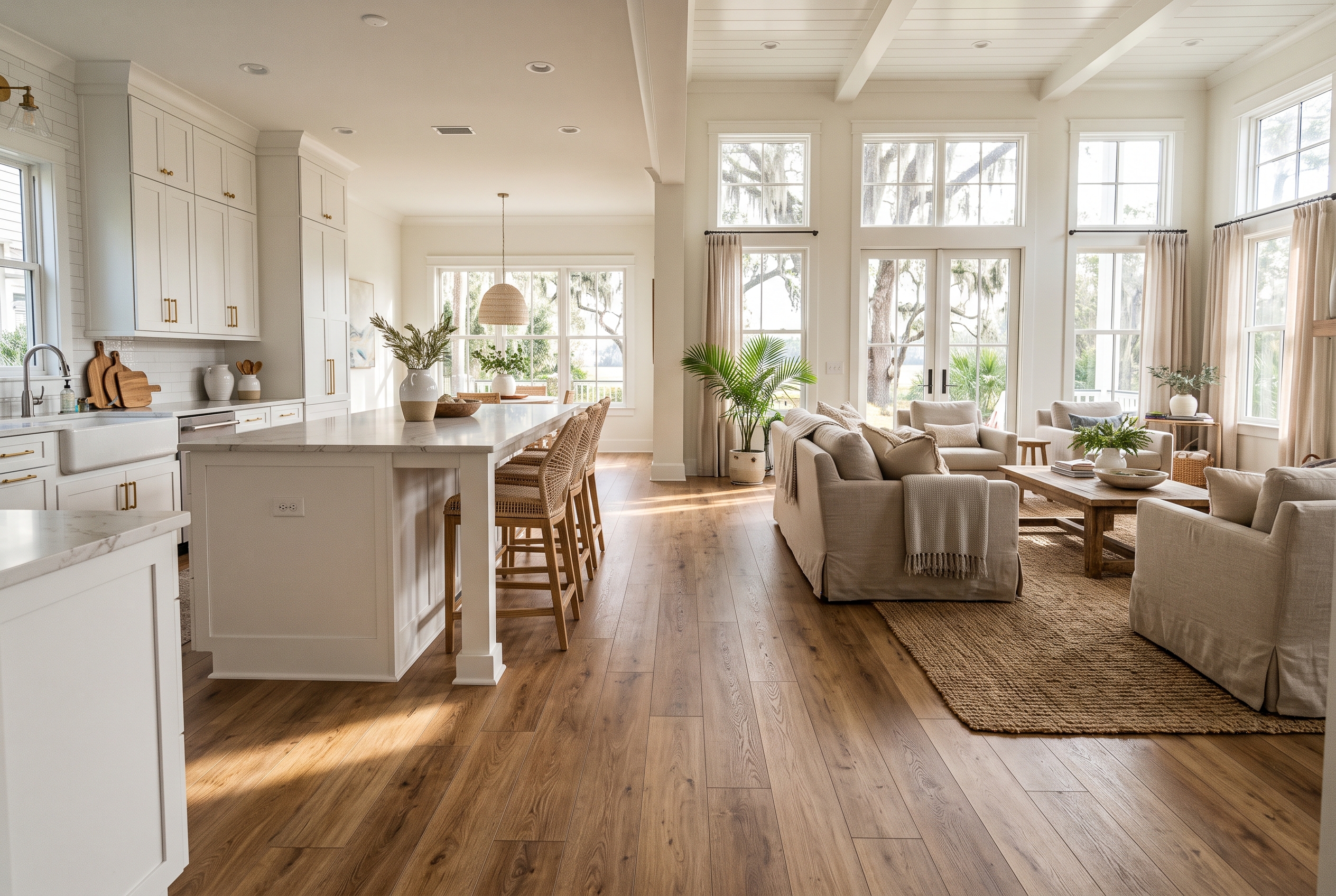
If the floor will see standing water, from a tub, a washing machine or a dishwasher that might leak, luxury vinyl plank is the safer floor. In living rooms, bedrooms and halls, laminate holds its own and often wins on crisp wood looks, sun and price. Waterproof laminate closes most of the gap in a kitchen, as long as spills are wiped up the same day.
| Your room or house | Better pick | Why |
|---|---|---|
| Full bath, laundry room | Luxury vinyl plank | Core can't swell from water |
| Kitchen | Either; waterproof laminate or vinyl | Spills get wiped; leaks are rare |
| Living room, bedrooms, halls | Either; laminate often | Crisp look, firm feel, price |
| Sunroom, big south windows | Laminate | Heat moves vinyl more |
| Big dogs | Depends: scratches or accidents | Check AC rating or wear layer |
| Beach rental, sandy feet | Luxury vinyl plank | Wet feet, fast cleanups |
| Closed-up summer house | Laminate, or vinyl with AC on | Vinyl's heat limit |
What Laminate and Luxury Vinyl Plank Are Made Of
Laminate is a wood-fiber floor: a core of high-density fiberboard, a printed image of wood or stone on top of it, and a clear, hard melamine wear surface over that, with a backing layer underneath. Luxury vinyl plank (LVP) is a plastic floor, built in layers on PVC, with a printed film and a clear vinyl wear layer on top.
That one difference in the core explains most of what follows. Wood fiber swells when water gets into it but holds its size well in heat. Vinyl doesn't absorb water at all, but it grows and shrinks with temperature.
Luxury vinyl comes in two families: flexible planks that are glued down, and rigid-core planks that click together and float. Rigid cores are either SPC, a dense, thin stone-plastic composite, or WPC, a foamed core that's a little thicker and softer underfoot.
The boxes carry two different numbers. Laminate is rated by an abrasion test with an AC rating, from AC1 for light use up to AC5 and AC6 for heavy commercial floors. Vinyl's clear wear layer is measured in mils, thousandths of an inch, where 12 mil is a typical home floor and 20 mil a heavy-use one.
Which Handles Water Better
Luxury vinyl plank handles water better, because its core can't absorb it. A spill, a dripping faucet or a wet dog on vinyl is a cleanup. Laminate's wood-fiber core is where water does its damage: when water works into the joints and reaches the core, the plank edges swell and peak, and swollen laminate doesn't shrink back.
Neither floor makes the room waterproof. Water that gets under a floating floor, from a leaking supply line or a flood, sits on the subfloor whatever the planks are made of, and it has to come out. Vinyl planks don't absorb that water, so they may be reusable once the subfloor is dry; laminate planks that took on water are replaced.
The words on the box matter here, since a water-resistant floor only handles surface moisture for a while, and a waterproof one is built for more. The North American Laminate Flooring Association (NALFA) advises against laminate in wet rooms such as bathrooms unless its maker labels it waterproof.
Is Waterproof Laminate Really Waterproof?
Yes, for spills and wet mopping on the surface, but not for standing water from a leak or a flood. Waterproof laminate seals the top and the joints, so liquid sits on the surface until you wipe it up. Mohawk built its RevWood Plus line around a water-repellent coating, a pressed bevel and tight locking joints that keep water from reaching the core, and it rates those floors for regular wet mopping.
The cut edges at the walls lose that factory protection, so the perimeter of a waterproof laminate floor gets sealed when it goes in. After that, wipe big spills the same day. The warranty paperwork for each line spells out what water it covers, and that document is the one that counts for your floor.
The waterproof laminate in our catalog runs to 14 styles, with water-resistant lines for drier rooms.
Which Resists Scratches and Dents Better
If scratches worry you more than dents, look hard at laminate; if heavy furniture and dropped pans worry you more, look at a thick vinyl wear layer. Flooring guides split on which surface resists scratches better. Laminate's melamine top is hard, while vinyl's softer surface gives a little under an impact, and both arguments have something to them.
What settles it for your floor is the number on the box. For laminate, AC3 suits most homes and AC4 suits busy ones, and about three-quarters of the rated laminate in our catalog is AC4. For vinyl, a 12 mil wear layer is a typical home floor and 20 mil suits kids, dogs and kitchens, and about six in ten colors of our luxury vinyl carry a 20 mil layer.
Heavy point loads are where vinyl needs care. A refrigerator, a piano leg or a heavy chair concentrates weight on a small spot, and a flexible plank can hold the dent. Wide furniture protectors spread the load, and appliances go in on a sheet of hardboard instead of being rolled straight across the floor. Laminate resists dents well but can chip at an edge if something heavy lands on a joint.
Laminate vs. Vinyl Plank With Dogs and Kids
With dogs, start with what worries you more. If it's claws, a high-AC laminate with a textured surface hides scratches well. If it's accidents and splashing water bowls, luxury vinyl plank or a waterproof laminate is the safer floor, since urine and water that reach a standard laminate's joints swell the edges.
Hard click floors of either kind can sound clicky under claws, and both can be slippery for an older dog. A matte, textured surface gives paws more grip, and a runner down the main path helps a senior dog most. Blot accidents right away and wipe the spot with a cleaner the floor's maker approves, so nothing sits in a seam, and put a washable mat under the water bowl.
With kids, spills point to vinyl or waterproof laminate, while dropped toys and ride-on cars don't favor either much. A 20 mil vinyl or an AC4 laminate handles a busy family room.
Sun, Heat and Sunrooms
In a sunroom, a Florida room or under big south and west windows, laminate is the more stable floor, because vinyl grows with heat. Mannington's own care page for its rigid vinyl warns that prolonged direct sun can discolor the floor and that excessive heat can expand it until it buckles.
Rigid-core vinyl moves less than flexible glue-down vinyl, but it still moves. Close blinds or drapes where strong sun hits the floor at peak hours, or put thermal UV film on the glass, which protects any floor.
Our area adds a twist: second homes and vacation rentals that sit closed up in July with the air conditioning off. A shut-up house on the coast can bake, and heat is what vinyl's limits are about, while laminate's limits are about humidity. If the house will sit closed in summer, set the thermostat to a reasonable ceiling instead of turning it off, or lean toward laminate. Both floors list their temperature and humidity limits in the carton, and staying inside them protects the floor and the warranty.
Which Feels and Sounds Better Underfoot
Luxury vinyl usually feels a little softer and warmer underfoot, and laminate feels firmer and crisper. Both are hard floating floors, though, and the pad under them changes the feel and the sound more than the core does.
A rigid vinyl or a laminate with no pad can sound hollow and clicky, especially upstairs, where footsteps carry to the room underneath. Many planks now come with a pad attached; others need an underlayment, and the right one quiets either floor and softens the step.
To judge, stand on samples in socks and tap them with a heel. The hollow ones sound hollow, and the ones with a good pad sound like a floor.
Which Looks More Like Real Wood
The best of both look convincingly like wood, and the tells are the same on each. Look for texture that follows the printed grain, called embossed in register, plank edges with a real bevel, varied plank lengths, and enough different board images that the same knot doesn't repeat every few feet.
Laminate's harder surface takes a deep, crisp texture that reads as real wood up close. Vinyl's printing has caught up, and its softer surface feels a little warmer to the hand.
In a showroom, lay out six or eight planks from different cartons and look at them from standing height, the way you'll see the floor at home, before you judge a single sample board.
Which Is Better in Each Room
Water settles the wet rooms, and sun, feel and price settle the dry ones. Kitchens can go either way, baths and laundry rooms lean to vinyl, and living areas often lean to laminate.
Kitchens
In a kitchen, luxury vinyl plank and waterproof laminate both work. Most kitchen water is spills, and both handle spills. The real risk is a slow leak from the dishwasher or the refrigerator's ice-maker line that nobody sees for weeks, and vinyl forgives more of that.
A floating floor goes in after the cabinets and runs up to them, so it can move. Choose an AC4 laminate or a 20 mil vinyl for the traffic between the sink, the stove and the refrigerator. With waterproof laminate, the perimeter at the cabinets and walls gets sealed.
Put a washable mat at the sink, and look under the dishwasher and behind the refrigerator now and then. A drip caught early is a towel; a drip found in a month is a repair.
Bathrooms and Laundry Rooms
For a full bath with a tub or shower, and for a laundry room, luxury vinyl plank is the safer floor. Steam, wet feet and a washing machine that might overflow all favor a core that can't swell.
The edges are what keep a bathroom floor dry underneath. The joint at the tub and around the toilet gets a flexible sealant, and in a laundry room a drain pan under the washer catches a leak before it reaches the floor. Glue-down vinyl leaves no joints for water to find, which suits a bath with a lot of splashing.
Waterproof laminate goes in a full bath only where its maker approves it, with the perimeter sealed. A powder room with only a sink can take either floor, and matching the hall floor often looks best there.
Living Rooms, Bedrooms and Halls
Living rooms, bedrooms and halls can take either floor, and here laminate often wins. It stays stable in sun, feels firm underfoot, usually costs a little less, and its texture reads well across a big room.
Upstairs, the pad matters most, since a hard floor over a bedroom ceiling carries footsteps down. Choose planks with a good attached pad or a sound-reducing underlayment.
Long runs through a house need planning on either floor. Both float, so both need room to move, and each carton sets the longest run before a transition is needed. Running one floor through the main living areas, with transitions only at doorways, makes the house feel bigger.
Beach Houses, Rentals and Second Homes
For a beach rental, luxury vinyl plank is usually the better floor, because wet, sandy feet and fast turnovers between guests call for a tough wear layer that cleans up quickly. Choose a 20 mil wear layer where sand comes in, and put mats inside and outside every door, since sand is what wears a floor's surface.
For a house that sits closed in summer, keep the air conditioning set to a high ceiling instead of off, which protects a vinyl floor from heat and a laminate floor from humidity. For a rental, a mid-tone, textured plank hides sand and scuffs between cleanings.
Keep a few spare cartons from the same run. On either floor, a damaged plank can be swapped, and the match is far easier with boards from the original lot.
How Each One Is Installed
Laminate and luxury vinyl plank usually float: the planks click together and rest on the subfloor, so the floor can move. Flexible vinyl can also be glued down, which suits rooms with heavy rolling loads or lots of water. Either way, the work goes in this order:
- Take up the old floor, or confirm the existing floor is flat and sound enough to cover.
- Flatten the subfloor, because both floors telegraph dips and humps, and rigid planks rock over them.
- On a concrete slab, put down a moisture barrier. NALFA calls for a slab cured at least 90 days and a 6-mil vapor barrier under laminate; many vinyl lines set their own rules in the carton.
- Add the underlayment, unless the planks have a pad attached.
- Leave the expansion gap the carton calls for at every wall, and plan transitions at doorways and long runs.
- Finish with baseboard or quarter round over the gap, transitions to other floors, and stair nosing on any steps.
Homes here sit on two kinds of floors: concrete slabs, where the moisture barrier is the step that matters, and wood subfloors over crawlspaces, where flatness and a dry crawlspace matter most. Either floor can go over existing tile if the tile is flat and the grout lines are filled, and either can go on stairs with a stair-nose piece on each tread.
Both are popular do-it-yourself floors in a simple, square room. Stairs, long runs, rooms full of doorways and a subfloor that needs leveling are where a professional install pays for itself.
What Laminate and Vinyl Plank Cost
The national figures put laminate at about $3 to $13 a square foot installed and luxury vinyl at about $3 to $18, with most vinyl jobs landing between $5 and $10. They come from cost data gathered from homeowners after their projects were finished. Labor runs about $2 to $8 a square foot for laminate and $2.50 to $6 for vinyl, and laminate planks alone run about $1 to $6.50 a square foot.
| Floor | Installed, per sq ft | A 400 sq ft main floor |
|---|---|---|
| Laminate | $3 to $13 | $1,200 to $5,200 |
| Luxury vinyl, typical | $5 to $10 | $2,000 to $4,000 |
| Luxury vinyl, full range | $3 to $18 | $1,200 to $7,200 |
Floating vinyl runs about $4.50 to $8 a square foot installed and glue-down about $5 to $10. Underlayment, where the planks don't have a pad, adds about $30 to $60 per 100 square feet, and taking up an old floor runs about $400 to $600 per 200 square feet. Stairs, leveling and transitions add their own lines.
We price your rooms when we measure them, because the floor you choose, the subfloor and the stairs are what move the total.
How Long Each Lasts and What Can Be Repaired
Either floor lasts many years in a room that suits it, and what ends a plank's life differs. On laminate, it's water that reaches the joints; on vinyl, it's a wear layer worn through in a traffic lane or a dent under a heavy load.
Both can be repaired a plank at a time. On a click floor, planks can be unclicked from the nearest wall to reach a damaged one, or a damaged plank can be cut out and a new one set in. That's why the spare cartons matter.
Most laminate and vinyl lines carry long residential warranties that cover wear, stains and manufacturing defects, and the water coverage is the part that differs most from line to line. The paperwork that comes with your floor is what counts, so keep it with the spare cartons.
When Laminate or Vinyl Plank Goes Wrong
Swollen, peaked edges on laminate almost always mean water reached the joints. The swollen planks get replaced, and the subfloor gets dried before new planks go down, or the problem comes back.
A laminate floor that buckles or lifts across a room has usually run out of room to move. The expansion gap may be too small, something may be pinning the floor, or the house got very humid. Trimming the gap at the walls or freeing whatever pins it often lets it settle, and a floor that stays lifted gets relaid.
Vinyl that gaps or peaks near a window has usually overheated, or it was pinned under cabinets when it went in. Cool the room, shade the window and free any pinned edge; planks that stay peaked get relaid. A dent in vinyl is fixed by replacing the plank.
A floor that clicks, flexes or sounds hollow as you walk is usually sitting over a dip in the subfloor. The fix is to lift that section, level the low spot and relay it. A leak under any floor can't wait, so shut off the water, pull up what's wet and get the subfloor drying the same day.
Laminate and Vinyl Plank in Our Catalog
At Waccamaw Floor Covering, we keep laminate and luxury vinyl plank side by side in our showroom at 1717 4th Avenue in Conway, and our crews install both. The laminate includes Mohawk's RevWood collections, such as Castlebriar, Adler Creek and Miramar Shores, Chesapeake Flooring's All American Premium and Freedom, TRUCOR's Tymbr Select and Bruce TimberTru.
Mannington makes both, with its Restoration Collection laminate and its ADURA Max, Rigid and Flex vinyl. The luxury vinyl runs to more than 400 styles in all, including Karndean's Korlok, Van Gogh and LooseLay. The waterproof vinyl filter narrows the choice to waterproof lines, and click and glue-down vinyl plank we keep in stock can go in sooner.
We install laminate and luxury vinyl plank with the underlayment, moisture barrier, stair nosing and transitions each job needs, and our services include emergency flooring repair and warranty follow-up after the floor is in. When you're ready, we come out, measure the rooms, check the subfloor and price both floors side by side.
Questions We Get About Laminate and Vinyl Plank
Is luxury vinyl safe to have in my home?
Yes, and the label to look for is FloorScore. FloorScore, administered by SCS Global Services and promoted by the Resilient Floor Covering Institute, certifies that a hard-surface floor meets California's limits on chemical emissions into indoor air.
Check the box or the spec sheet for the seal, and air the room out well after any new floor goes in.
Can I put laminate in some rooms and vinyl plank in others?
Yes, and plenty of homes do: vinyl in the baths and laundry room, laminate in the living areas. Choose two floors in related tones and change from one to the other at a doorway, never in the middle of an open room.
The two floors are often different thicknesses, so the transition piece at that doorway matters. Plan it before you order, so the heights work out.
Do laminate and vinyl plank need to acclimate?
Yes, follow the carton. Some floors ask for the boxes to sit in the room before installation, and others can go straight down as long as the room is already at its normal living temperature.
Either way, the heating or air conditioning should be running as it will be when you live there, before and after the floor goes in.
Walking on Both Before You Choose
Tell us the room, the sun it gets, the pets and the water it sees, and stand on samples of both in socks. We'll measure the rooms and price laminate and vinyl plank side by side, so you can choose with both numbers in front of you.


