


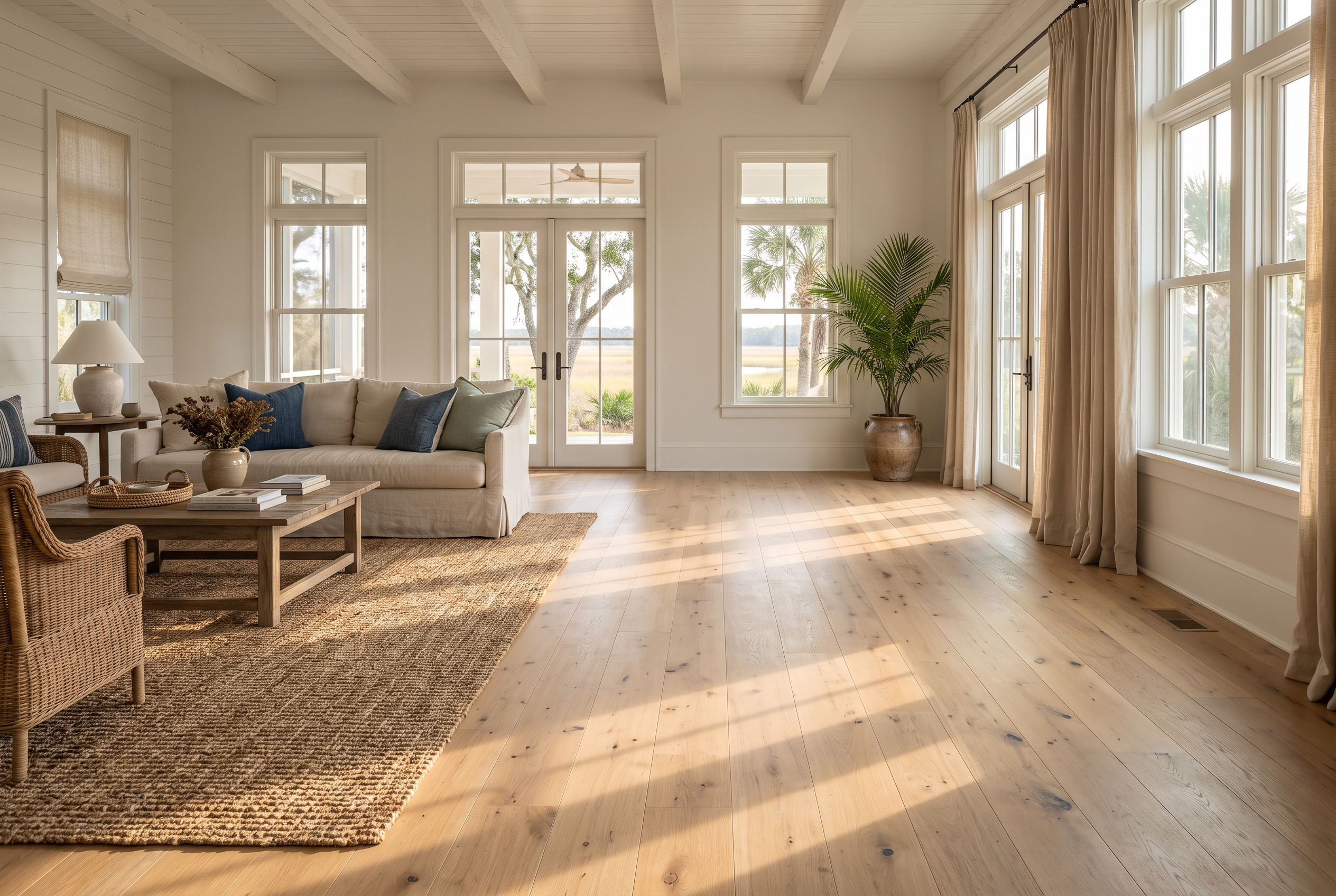
Oak is the right floor for most houses. Choose white oak for a tan, even floor that suits light, natural and gray finishes, or red oak for warmth, a lively grain and the most forgiving stain at a lower price. Hickory is the pick for big dogs and busy kids, maple for a pale, quiet floor you won't stain dark, and walnut for a rich floor in rooms that see little wear.
| Species | Janka hardness | Look | Best for |
|---|---|---|---|
| Red oak | 1,290 | Warm, pinkish, bold grain | Stain colors, traditional rooms |
| White oak | 1,360 | Tan to gray-brown, calm grain | Natural, light and gray looks |
| Hickory | About 1,800 | Light and dark in one board | Dogs, kids, rustic rooms |
| Maple | 1,450 | Pale, even, fine grain | Light modern rooms, unstained |
| Walnut | 1,010 | Chocolate brown | Bedrooms and formal rooms |
| Cherry | 950 | Rosy brown that deepens | Low-traffic rooms |
| Amendoim | 1,780 | Reddish brown | Busy rooms, warm look |
| Brazilian cherry | 2,690 | Orange-red, darkens deep red | Hard wear, bold color |
What Janka Hardness Tells You About a Wood Floor
Janka hardness is the force it takes to press a steel ball halfway into a piece of wood, measured in pounds. A higher number means the wood resists dents better, whether from a dropped pan, a high heel, a chair leg or a big dog landing off the couch.
The gaps between species are real but smaller than the numbers suggest. Red oak at 1,290 and white oak at 1,360 behave almost the same in a home. Walnut at 1,010 dents noticeably more easily than oak, and hickory at about 1,800 shrugs off a lot of what marks oak.
What Janka doesn't measure is scratches. Everyday scratches land in the finish on top of the wood, so the finish, its sheen and the texture of the board decide how scratched a floor looks after a year. A matte, wire-brushed oak can look better with a dog than a glossy, smooth hickory. Use Janka to rule out soft species for hard rooms, then choose the finish to hide what Janka can't.
White Oak vs. Red Oak
Put a white oak sample next to a red oak sample and the difference you see is color, not hardness. Bruce's own comparison of the two lands in the same place: at 1,360 and 1,290, the hardness gap is too small to matter, so the choice comes down to looks.
White oak is pale, light brown to tan, with a straighter, calmer grain and a gray-brown undertone that sits well with both warm and cool finishes. Red oak runs pinkish-red to reddish-brown, with a bolder, wavier grain that hides everyday wear. That pink undertone is the thing to watch, because a light stain brings it out and a dark stain hides it. So a light gray or "no-stain" look usually means white oak, while a medium or dark brown can be either.
White oak's pores are plugged with tiny growths called tyloses, which is why it has long been the wood for watertight barrels and boats. That closed grain helps it shrug off spills better than red oak, whose open pores soak up liquid. In humid air, though, both oaks swell and shrink about the same, so neither one solves summer cupping on its own.
Red oak usually costs a little less, and white oak a little more because of demand.
To compare them in your house, lay a sample of each on the floor beside your trim and cabinets. Look at noon and again at night under your own bulbs, since warm lighting makes red oak read pinker. With white or gray cabinets, white oak is the easier match; with warm wood or cream cabinets, red oak often looks richer. To tell them apart on an existing floor, look at the end of a board: red oak's pores are open little holes, while white oak's are filled in.
Hickory and Pecan Floors
Hickory is one of the hardest domestic woods for a floor, at about 1,800 on the Janka scale, and it's the species to pick when dents are the worry. A single hickory board can run from cream to dark brown, so the floor looks lively and rustic, and it hides dirt, scratches and dog hair well.
That variation can also look busy in a formal room or a small one. A higher grade with less color swing, or a darker stain, calms it down. Pecan belongs to the hickory family, and pecan floors look and wear much the same.
Hickory moves more with humidity than oak, so on our coast it does best as an engineered plank or in a narrower solid board. Hickory in our catalog runs to 39 styles, from smooth to hand-scraped and from natural to deep brown.
Maple Floors
Maple is the floor for a pale, quiet, modern look. It's hard, at 1,450 on the Janka scale, with a fine, even grain and a blonde color that suits Scandinavian and mid-century rooms, and it's the classic wood of basketball courts.
Maple's tight grain is also its limit, because it doesn't take stain evenly. The Maple Flooring Manufacturers Association recommends against staining or bleaching maple strip flooring at all, since most of the surface ends up blotchy. Choose maple for its own color, or for a color the factory has already applied, rather than for a stain added on site.
Maple is mildly sensitive to light and mellows slowly over the years, and it moves a little more with humidity than oak. Maple in our catalog comes in both solid and engineered planks, mostly in natural and light tones.
Walnut, Cherry and Other Softer Woods
If you want a rich, dark floor in a bedroom, a dining room or a quiet living room, walnut is the species. In a busy kitchen or a house with big dogs, it isn't. American black walnut has a chocolate-brown color no stain fully copies, but at 1,010 on the Janka scale it dents more easily than oak.
A matte finish and a character grade make those dents far less noticeable, and felt pads under the dining chairs prevent most of them. Walnut moves less with humidity than oak, which helps on the coast. Walnut in our catalog includes engineered planks such as Mannington's Maison Collection Artisan Walnut.
American cherry is softer still, at 950. It starts a pale, rosy brown and darkens to a deep reddish brown with time and light, which can surprise you if you chose it for the color on the sample. Treat it like walnut: a beautiful floor for rooms that see little wear.
"Brazilian walnut" is not walnut at all. It's ipe, a South American wood rated about 3,490 on the Janka scale, more than three times as hard as black walnut, and it belongs with the imported species.
Amendoim, Acacia and Other Imported Woods
Imported species are the floors to choose when you want more hardness than oak and a warm, distinctive color. Amendoim comes from South America and rates about 1,780 on the Janka scale, close to hickory. Its heartwood is a light to medium reddish brown that darkens with age, and it reads warmer and calmer than hickory.
Brazilian cherry, the wood sold as jatoba, is much harder, at about 2,690. It starts orange-brown and darkens to a deep red with light, so it suits you if you want that red. Despite the name, it isn't related to American cherry.
Acacia covers a large family of trees. The acacia sold as flooring is very hard, about 2,220 on the Janka scale in national cost data, and it swings in color from honey to dark brown within one board. Acacia in our catalog comes in solid planks, smooth or hand-scraped.
Very dense woods are harder to cut and nail, and many of them come as engineered planks, which keeps them stable and saves the costly species for the top layer. Expect imported species to change color more than oak in their first months.
Ash and Heart Pine
Ash suits you if you like the grain of oak but want more contrast. It's about as hard as white oak, at 1,320 on the Janka scale, with a pale color and a bold grain, and it takes stain well.
Heart pine is the old Southern floor, cut from the heartwood of longleaf pine, with a warm amber color and a hardness around 1,225. Other pines are far softer and dent easily, so a pine floor is a look you choose knowing it will show its life.
Which Hardwood Species Take Stain Best
Red oak takes stain the most evenly of the common species, from a light honey to a deep espresso, because its open grain soaks up color consistently. If a stained floor is the plan, start your samples there.
White oak takes brown and natural finishes well and is the usual choice for gray, white-washed and "raw wood" looks, since there's no pink undertone to fight. Maple and birch blotch under most stains, as the maple makers' association warns. Hickory's own light and dark streaks show through any stain, so stained hickory still looks like hickory.
Two cautions apply to every species. Dark stains show dust, pet hair and scratches more than mid-tones do. And a small sample never looks the same as a whole room, so look at a full carton's worth of boards, or a large factory sample, in your own light before you choose.
How Each Species Changes Color Over Time
Every wood floor changes color with light and age, and the species sets how much. Cherry and Brazilian cherry darken the most, deepening toward red, and amendoim darkens with age as well. Oak, hickory and maple are only mildly sensitive to light, so they change slowly and less.
Most of the change happens in the first months. A rug moved after a year can leave a lighter rectangle on a cherry floor, while on oak the difference is slight. Our hardwood catalog even has a Light Sensitivity filter, so you can see which floors change most before you choose.
Sun on the coast is strong, and a big south- or west-facing window bakes a floor every afternoon. Curtains and UV-resistant film on large windows and glass doors slow the change, and moving rugs and furniture now and then in the first year lets the floor age evenly.
Hardwood Species and Coastal Humidity
Every species swells in a humid summer and shrinks in a dry, air-conditioned or heated winter, but some move more than others. In the figures the federal Forest Products Laboratory publishes for wood flooring, hickory moves the most of the common species, red oak and sugar maple a little less, and black walnut and black cherry the least.
Picture a 5-inch flat-sawn board going through a 4-point swing in moisture content. It changes width by about 8 hundredths of an inch in hickory, about 7 in red oak and maple, and about 5 in walnut and cherry. That's the difference between a gap you notice in February and one you don't.
Construction matters more than species, though. An engineered plank's cross-layered core is what keeps a wide board from cupping in our humid summers and gapping in winter. Whatever the species, keep the house in the range the maker sets. Bruce asks for 35 to 55 percent relative humidity, with a humidifier in heating season to keep gaps from opening, and a small hygrometer tells you where your house sits.
Grade, Cut and Plank Width Matter as Much as Species
Two floors of the same species can look nothing alike, because the grade, the cut and the width change the look as much as the species does. A clear or select grade shows few knots and little color variation, while a character or rustic grade shows knots, mineral streaks and color swings. The same white oak can come in grades with names such as Prestige, Excel and Advantage, and they look like different floors.
The cut decides the grain pattern. Plain-sawn boards show the cathedral arches you probably picture. Rift-sawn and quartersawn boards show straight, tight lines, and quartersawn oak adds silvery ray flecks. Both of those cuts also move less across their width, which helps in humid weather, and a live-sawn floor mixes all three.
Wider planks swell and shrink more across their face than narrow ones, so wide boards on the coast are usually engineered. Either way, an engineered floor carries real wood of the same species as its top layer, so every species comes both ways.
The Best Species for Dogs, Kids and Kitchens
The household decides the species more often than the look does. Dogs call for hardness and a forgiving finish, kids for a floor that's easy to live with and easy to match later, and kitchens for a stable plank and a tough factory finish.
Hardwood With Dogs
With big dogs, choose hickory or a character-grade oak in a matte or wire-brushed finish and a mid-tone color. Hickory resists dents from claws and dropped bones, and its grain and color swings hide scratches. The imported species, amendoim, acacia and Brazilian cherry, are harder still if the look suits you.
The finish matters as much as the wood. A low sheen doesn't catch light along a scratch, and a textured, wire-brushed or hand-scraped surface hides marks among its own. Skip walnut, cherry and glossy dark floors, which show every claw mark and every bit of dust.
Keep nails trimmed, put a washable mat under the water bowl and at the doors, and wipe up accidents quickly, since urine left on wood stains it.
Hardwood With Kids
With kids, oak is the steady choice. It's hard enough for dropped toys and chair legs, its grain hides daily wear, and it's the easiest species to match if you add a room or replace a section years later.
Choose a mid-tone color, which hides crumbs and scuffs better than very light or very dark floors. Area rugs in the playroom and the bedrooms soften falls and quiet a two-story house.
Hardwood in Kitchens
For a kitchen floor, choose oak or hickory as an engineered plank with a factory finish. The engineered core handles the humidity swings of cooking and the dishwasher better than a solid board, and the factory finish arrives ready to use.
The sink and dishwasher zone is where wood floors get into trouble. Put a washable mat at the sink, wipe spills when they happen, and fix a dripping dishwasher right away, since standing water is hard on any wood. Bedrooms are the easy rooms, which is where walnut and cherry shine.
What Hardwood Costs by Species
Nationally, installed hardwood costs about $6 to $25 a square foot in cost data from more than 10,000 homeowners' finished jobs, with labor alone about $3 to $6. Solid hardwood runs about $10 to $25 a square foot installed, and engineered about $5 to $20.
The same survey data puts engineered planks at about $5 to $8 a square foot for hard maple, $6 to $8 for white ash, $5 to $10 for acacia and $8 to $16 for Brazilian cherry. Among the oaks, red oak usually costs a little less than white oak, which is in high demand.
| Floor | Installed, per sq ft | A 500 sq ft floor |
|---|---|---|
| Hardwood overall | $6 to $25 | $3,000 to $12,500 |
| Solid hardwood | $10 to $25 | $5,000 to $12,500 |
| Engineered hardwood | $5 to $20 | $2,500 to $10,000 |
Within the domestic species, the grade, the plank width and length, and solid versus engineered usually move the price more than the species does. A wide, long, clear-grade white oak plank costs far more than a narrow character-grade one of the same tree. Removing the old floor, fixing the subfloor, stairs and transitions are separate lines on a quote, and on a whole-house job they can add as much as the species choice.
We price your rooms when we measure them, because the species, grade and width you pick and what's under the old floor are what move the total.
Hardwood Species in Our Catalog
At Waccamaw Floor Covering, we sell and install hardwood from our showroom at 1717 4th Avenue in Conway. Oak makes up about half of the colors in our hardwood catalog, maple about a sixth, and hickory, walnut, ash, acacia and amendoim the rest.
For oak, there are Bruce's solid and engineered floors, Appalachian Flooring's Signature, Alta Moda and Verita lines, and LM Flooring's Town Square and Lauderhill. Hickory comes from several makers, including Mohawk, Shaw and Mullican. Maple runs through the same Appalachian lines and Anderson Tuftex's Bernina and Ellison, walnut includes DuChateau's Vernal, acacia comes from Legendary Floors, and amendoim from Indusparquet.
The catalog filters by species, construction and Janka rating, and every floor has a See in my room button. We install the hardwood we sell, and among our photos of finished jobs are hardwood floors in Conway and Georgetown. When you're ready, we come out, measure the rooms and price the species you're leaning toward.
Questions We Get About Wood Species
Can I mix wood species in one house?
Yes, as long as each species ends at a doorway or a clear break, and two species don't meet in the middle of one open room. A walnut bedroom off an oak hall looks planned, while two species side by side in one living area look like a repair.
Keep the tones related, warm with warm or cool with cool, so the house reads as one plan.
Should a new floor match the hardwood in the next room?
No, not usually. A new board rarely matches an old one that has darkened for years, so a clearly different floor separated by a threshold at the doorway tends to look better than a near miss.
If the rooms flow together with no doorway, a full match means the same species and stain, and the new floor will still look lighter for its first year.
Which species is best for stairs?
For stairs, oak and hickory are the usual species, because treads take the hardest wear in the house, on the same spot of every step. Softer species such as walnut and cherry show wear on the front edge of the tread quickly.
Match the treads to the floor species where they meet, and choose a matte finish, which hides the wear path better than a glossy one.
Seeing the Species in Your Own Light
Take two or three samples home and look at them on the floor in the morning and in the evening, next to your cabinets and your trim. Then we'll measure the rooms and price the one that still looks right at night.


