


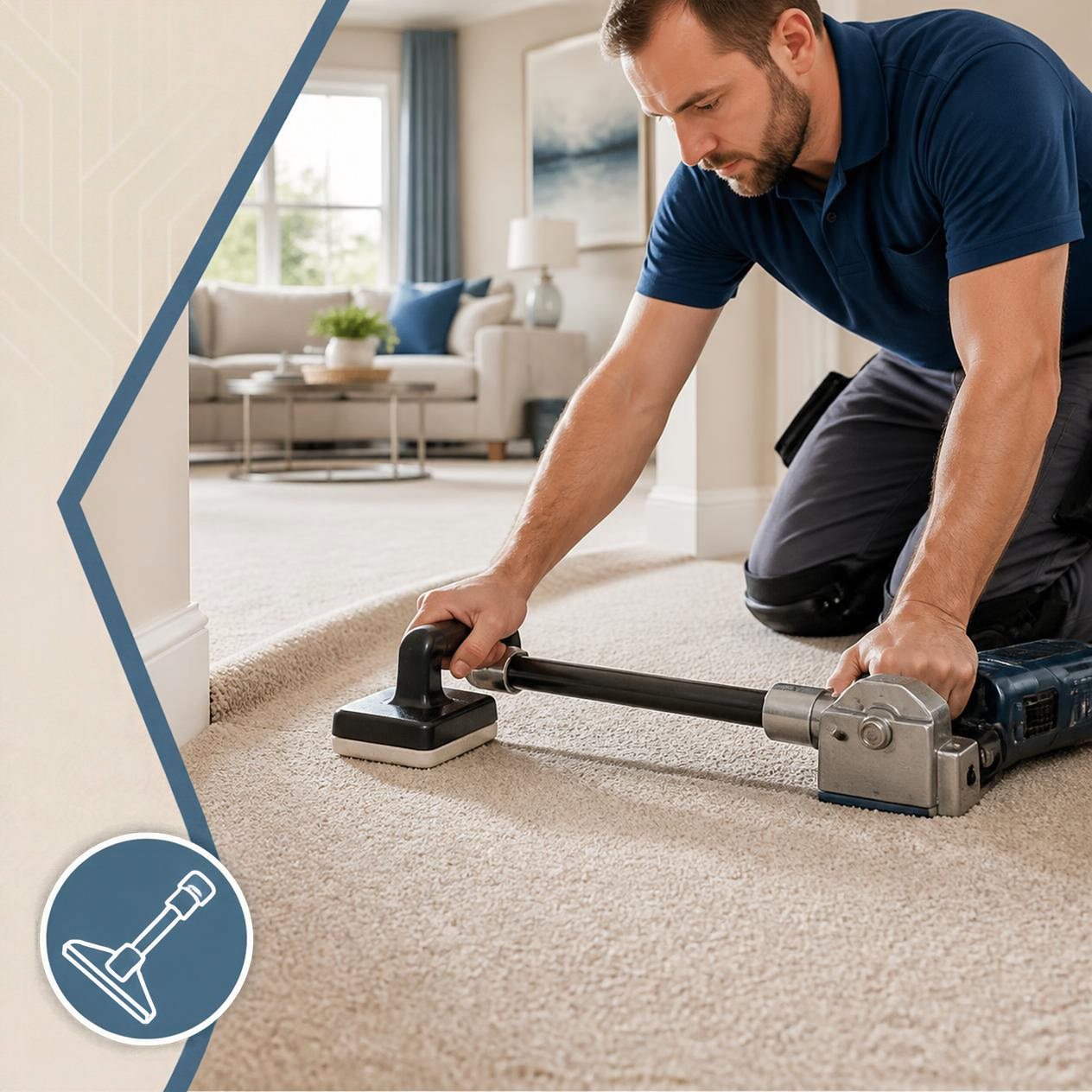
When carpet ripples across a room, most people assume the carpet went bad. It usually didn't. The Carpet and Rug Institute (CRI), the standards body for the U.S. carpet industry, says flatly in its troubleshooting guidance that wrinkles are rarely a manufacturing defect and that proper installation is what keeps them from happening. In other words, a rippling floor is almost always telling you about the install, the cushion, or the humidity, and that's good news, because most of those problems can be fixed without tearing the carpet out.
We repair and re-stretch carpet across Conway and the Grand Strand, so we see the same handful of causes over and over. Here's what actually makes carpet wrinkle, when a re-stretch will fix it for good, when the backing or cushion means it's time to replace, and the smaller repairs, like burns, snags, and failing seams, that are worth doing before they spread.
Why Does Carpet Wrinkle, Ripple, or Bubble?
Carpet wrinkles because it was never stretched tight enough, because the cushion under it is wrong, or because heat and humidity have loosened it, and only rarely because the carpet itself failed. The CRI bulletin on carpet wrinkles is blunt about the biggest cause: a floor that was not power-stretched at installation will, in its words, eventually become warm, relaxed, and loose, no matter how tight it looked on day one. That slack has to go somewhere, and it shows up as waves and ripples months later, usually in the traffic lanes and near the walls.
Three culprits cover almost every case. The install left slack because it skipped the power stretcher. The cushion is too soft or too thick, so the carpet flexes and works loose over it. Or seasonal swings in temperature and humidity have relaxed the fibers and backing. The reason this matters for the fix is simple: the first two are correctable and the third is often temporary, so a rippling carpet is rarely the emergency it looks like.
Can Rippled Carpet Be Fixed, or Does It Need Replacing?
Most rippled carpet can be fixed with a professional re-stretch, as long as the carpet and its backing are still sound. A re-stretch lifts the carpet off the tack strips, pulls it tight again with a power stretcher, trims the excess, and re-secures it. When the ripples came from a loose install or a humid season, that resets the floor and the waves stay gone. It's a fraction of the cost of replacement and usually a same-day job for a room or two.
Replacement becomes the honest answer when the backing has delaminated or the carpet is worn through. Delamination is when the carpet's secondary backing separates from the primary backing it's tufted into, and once that bond has failed, the carpet no longer holds tension and will ripple again after any stretch. Repeated buckling that returns after a proper re-stretch is the tell. Worn, matted pile in the same room is the other, because there's little point re-stretching a carpet that's near the end of its life anyway. When the fibers are gone, we'll say so and walk you through the carpet we stock rather than sell you a re-stretch that buys a few months.
What Is Carpet Re-Stretching, and Why Does It Take a Power Stretcher?
Re-stretching is the process of pulling a loose carpet tight again, and doing it right takes a power stretcher, the same tool a proper installation needs. The CRI bulletin calls power-stretching mandatory, specifying that carpet be stretched 1 to 1.5 percent over both its length and width with a pole-style power stretcher that braces wall to wall. It's equally clear that a knee kicker, the short tool many people picture, is designed for positioning carpet at edges and corners and can't stretch a whole room. Used to set the carpet at a doorway or a corner, a knee kicker is doing its job; used to install a whole floor, it's the reason that floor ripples.
The reach of a power stretcher is why re-stretching is worth hiring out. A power stretcher applies even, long-range tension that a person leaning on a kicker simply cannot match, and getting the tension right, hooking the carpet firmly onto securely fastened tack strip, is what makes the fix last. For runs longer than 30 feet, the CRI standard even calls for heavier architectural tack strip to hold that much pull. Done properly, a re-stretch is permanent for the life of the carpet; done with the wrong tool, the ripples are back by the next humid stretch.
Does Coastal Humidity Make Carpet Ripple in Horry County?
Yes, humidity is a real trigger for carpet rippling, and the Grand Strand serves up plenty of it. The CRI bulletin notes that changes in temperature and humidity can influence how badly a carpet bubbles or wrinkles, and it points out that carpet can even ripple after a wet cleaning and then relax back into place as it dries. Myrtle Beach averages about 73 percent relative humidity across the year, with mornings near 85 percent and afternoons dropping toward 55 percent, so a coastal carpet lives through a daily moisture swing of roughly 30 points that an inland floor never feels.
The humidity link cuts two ways when you're deciding what to do. A carpet that ripples only in the muggiest part of summer and flattens out again may need nothing more than patience, or a small re-stretch if it doesn't fully recover. But humidity is also why a coastal carpet has to be installed dead-tight in the first place, since any slack the installer leaves will be exaggerated the moment the air gets heavy. If your carpet ripples year-round, humidity isn't the whole story, and a loose install almost certainly is.
When the Cushion or the Seams Are the Real Problem
Sometimes the carpet is fine and the cushion underneath is the culprit. The CRI bulletin warns that a cushion that's too thick or too soft lets the carpet flex and work loose over it, and it recommends residential cushion no thicker than 7/16 inch. A plush, oversized pad feels great in the showroom and undermines the carpet in the hallway, because every footstep flexes the backing a little more. When we find the wrong cushion under a chronically loose carpet, fixing the ripple means replacing the pad first and then re-stretching what's above it.
Seams are the other repair people put off too long. A seam that was not hot-melted and rolled tight at installation will start to peak, fray, or open, and a small gap turns into a run once foot traffic catches it. Re-sealing or re-seaming a failing joint early keeps it from spreading into a replacement-sized problem. The same goes for edges at doorways and transitions, where a lifting metal strip or a frayed edge is both a trip hazard and the start of unraveling.
Other Carpet Repairs Worth Doing: Burns, Snags, and Pet Damage
Small carpet damage can often be patched invisibly, which saves replacing a whole room over one bad spot. A cigarette burn, a bleach mark, or a pet-chewed corner can be cut out and filled with a patch taken from a closet or a leftover remnant, so the repair blends into the surrounding pile. Snags and pulls get trimmed and secured rather than yanked, since pulling a loose loop can run a line across the carpet.
Pet damage is its own category on the coast, where humidity slows drying and locks odor in. Surface stains and snags are patchable, but urine that has soaked through to the cushion and subfloor is a different job, because the smell lives below the carpet and a surface repair won't reach it. When we assess pet damage, we check what's under the carpet before quoting, so the fix actually solves the problem instead of covering it.
Repair, Re-Stretch, or Replace: A Quick Comparison
| Symptom | Likely cause | Usual fix |
|---|---|---|
| Waves or ripples, pile still good | Install left slack, or humidity | Power re-stretch |
| Ripples return after a re-stretch | Delaminated backing | Replace the carpet |
| Carpet loosens over a soft, thick pad | Wrong cushion | Replace cushion, then re-stretch |
| Peaking or opening seam | Seam not sealed at install | Re-seam and seal |
| Burn, bleach spot, or snag | Localized damage | Patch or trim |
| Odor and staining into the cushion | Liquid soaked through | Replace affected carpet and cushion |
Questions We Get About Carpet Repair
How much does it cost to re-stretch carpet?
Re-stretching is priced by the room and the amount of furniture to move, and it's far less than replacing the carpet. A single room is usually quick, while a whole house or a lot of built-in furniture takes longer. We give you a firm number when we see the space rather than a guess over the phone, since the furniture and the room layout drive the time.
Will re-stretching damage my carpet?
No, a properly done re-stretch does not damage sound carpet. The power stretcher's pins grip the backing, not the face fibers, and the carpet is lifted, tensioned, and re-hooked onto the tack strip. The only carpet that struggles with a re-stretch is one whose backing has already delaminated, which is exactly the carpet that needs replacing anyway.
Can I re-stretch carpet myself with a knee kicker?
You can nudge a small area, but you can't properly stretch a room with a knee kicker, and the CRI is explicit that it's a positioning tool rather than a stretching one. A kicker leaves slack that reappears as ripples within months, so a DIY kick usually means paying to have it done right later. For anything beyond a corner, a power stretcher is the tool the job needs.
My carpet ripples in summer and flattens in winter. Is that normal?
A mild seasonal ripple that comes and goes with the humidity is common on the coast and often harmless, since carpet relaxes in damp heat and tightens as the air dries. If the carpet fully flattens again on its own, you can usually leave it. If it ripples and stays rippled, the underlying install is loose and a re-stretch will settle it for good.
Get Your Carpet Fixed Before It Spreads
A ripple, a peaking seam, or a burned spot rarely fixes itself, and each one gets more expensive the longer it waits, since slack tears at seams and small damage runs. If your carpet in Conway or anywhere along the Grand Strand has started to wave, buckle, or fray, request a free in-home estimate and we'll look at the carpet, the cushion, and the seams and tell you honestly whether a re-stretch and repair will do it or whether you're better off replacing. Carpet repair and stretching is part of what our crews handle, and when replacement is the smarter call, we can show you new carpet built to hold up to coastal humidity.


